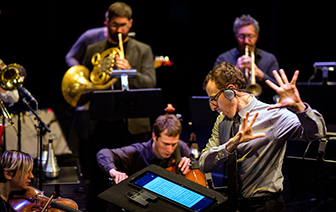
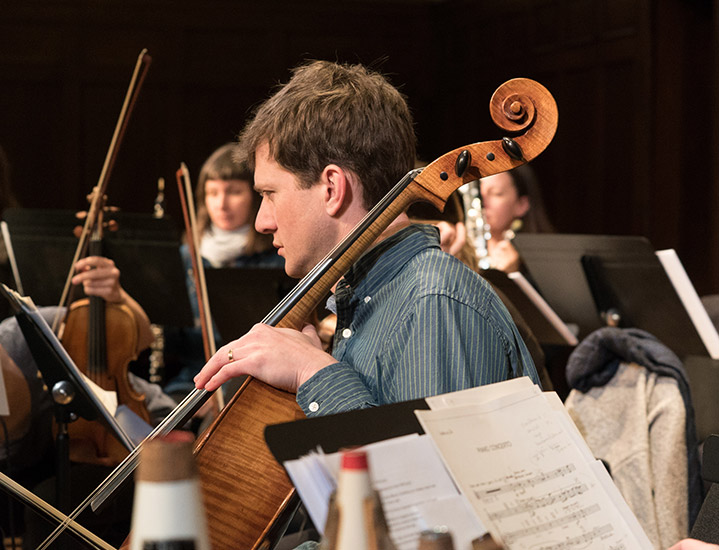
Alarm Will Sound will be artists in residence at the Met in the 2013-14 season. The residency will feature four performances, including site-specific collaborations with Kate Soper, Nigel Maister, and John Heginbotham Dance that will explore and exploit various gallery spaces.
“This season is about the Met as a generative force,” says Limor Tomer, the Met’s Concerts & Lectures General Manager. “We are inviting performers and thought-leaders to dig into the tissue of the Met itself, and engage with the ideas that the building generates.”
The season also includes the New York premiere of Steve Reich’s Radio Rewrite and a program entitled The Permanent Collection in which we imagine our own musical version of the Metropolitan Museum's permanent collection, developing a canon for the new music ensemble.
The Met's season expands its traditional offerings (such as early music and the Vienna Boys Choir) with an emphasis on contemporary work, including collaborative performances by David Longstreth, Iva Bittová, and the Calder String Quartet (Bartók); by the NY Phil (HK Gruber); by Gotham Chamber Opera (Beecher and Moscovitch world premiere). The museum also celebrates the music of John Zorn and Arvo Pärt with innovative concerts staged all over the museum.
Tomer says that many of the performances, “literally take you from gallery to gallery! I hope this will be a revelatory, unexpected, and fun season for our audiences.”
Kate Soper has won a Koussevitzky Foundation Commission Grant to write a new work for Alarm Will Sound. The piece will be a collaboration with Nigel Maister, our Staging Director.
MAP Fund will support the development of Donnacha Dennehy’s The Hunger, a multimedia theater piece on the Great Irish Famine, composed for Alarm Will Sound, Dawn Upshaw, and Iarla O’Lionáird. Through first-person accounts and socioeconomic analyses, the work will address both the human-scale and societal impact of the inequities that led to this historic tragedy. It will take advantage of Alarm Will Sound's uniquely extended performance skills by integrating the musicians into the staging, thereby creating an unconventional operatic experience.
A complete list of this year’s grantees is here.
Twice this season we've performed our multimedia work 1969. Inspired by a once-rumored but unconsummated meeting between the Beatles and Karlheinz Stockhausen—icons of 1960s rock and avant-garde composition, respectively—1969 connects the music, history, and ideas of a turbulent decade through the works of the Beatles, Leonard Bernstein, and contemporary composers Stockhausen and Luciano Berio.
“The story of a meeting between the Beatles and Stockhausen, each at the height of their fame, to plan a joint concert seemed rich with possibilities,” says Alan Pierson, our Artistic Director and the person who came up with the concept. “But there is also poignancy in the fact that this never happened. That became a metaphor for all the disappointments of the late 1960s, including the dreams of a new world that ended up not being realized in the way that people at the time envisioned.”
During the production, three on-stage screens display projected stills and videos of the era’s tumultuous events, including civil rights protests, riots, the Vietnam War, and the assassinations of Martin Luther King and Robert F. Kennedy. Actors deliver lines based on interviews and writings by John Lennon, Stockhausen, and Berio, and the musicians not only play their instruments, they sing and act, too, using the words of the decade’s cultural and historical figures.
We come up with such unconventional projects in large part because of our roots at the Eastman School of Music, where most of us met as students, and where the environment encouraged us to push our artistic boundaries. This video gives a glimpse of 1969 and our recent homecoming at Eastman.
Steve Reich's music has had over many decades an influence on composers and bands outside the classical tradition. David Bowie and Brian Eno, for example, used techniques pioneered by Reich in the 1970s. Post-rock and indie musicians like Sufjan Stevens and Godspeed You! Black Emperor continue to take cues from Reich's compositional tactics.
With his newest work, composed for Alarm Will Sound and the London Sinfonietta, Reich turns the tables by mining the work of Radiohead: Radio Rewrite is inspired by materials from two Radiohead tunes, "Everything in its Right Place" and "Jigsaw Falling into Place." Alarm Will Sound gave the US Premiere on March 16 on the Stanford Live series in Palo Alto.
Reich's music has been a touchstone for Alarm Will Sound since our inception. Our first concert featured his work, and his influence marks much of the music we have performed since, by a broad range of composers across many stylistic borders. We also happened to be involved with the Sacrum Profanum Festival in 2011 when Reich heard Rodiohead's lead musician Johnny Greenwood perform Electric Counterpoint. It was there that the two met and the idea for Radio Rewrite was born.
We have been playing the music of Derek Bermel for several years, returning to it time and again because its eclectic influences are rich and varied. Canzonas Americanas, released on Cantaloupe Music, brings the stylistic variety of his work together in one album, capturing the many musical traditions of North and South America that are part of Derek's—and our—world.
“Derek Bermel synthesizes the diverse musical languages of his time into a unique, thoroughly individual American voice that is tuneful and rich, engaging and sophisticated,” says Alan Pierson, our Artistic Director. “Canzonas Americanas establishes Derek as a composer firmly in an American tradition like Copland, Ives, Gershwin, and Ellington before him.”
We are joined by the remarkable Luciana Souza whose voice evokes a Latin dreamscape in the last movement of the title track. Timothy Jones performs the song collection Natural Selection with theatricality. And Kiera Duffy adds her soprano to the arresting At the End of the World.
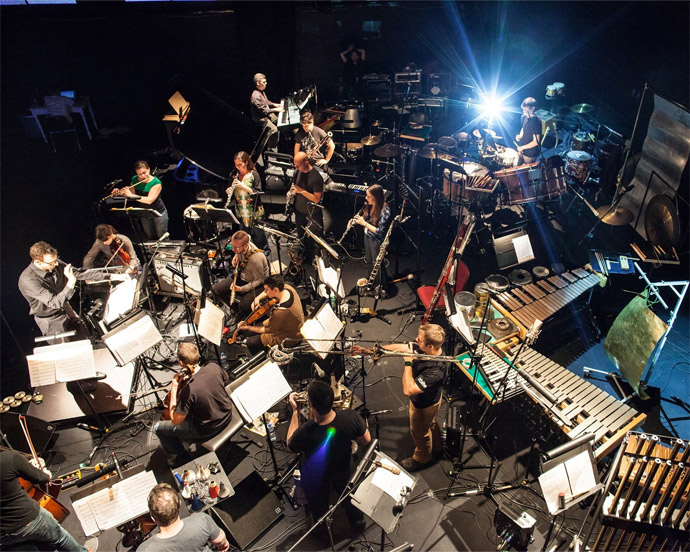
Alarm Will Sound is a twenty-member group dedicated to the creation, performance, and recording of today's most innovative music.
Payton MacDonald, one of our percussionists, and Jessica Johnson, our founding flutist, arranged this track for our Acoustica project.
Visit our Soundcloud for more recordings.

Mike grew up thinking he would be a doctor—his dad, grandpa, and uncles were all involved in biology. He didn’t start taking regular bassoon lessons until he was a sophomore in college, but he quickly realized he was more into music than science. Mike never imagined being in a group like Alarm Will Sound, but he says it’s his most enjoyable playing outlet.
Mike recently earned his DMA from the Eastman School of Music. He currently lives in South Carolina with his wife, Jennifer. It’s rare for musician couples to find jobs in the same city, let alone the same university, but Mike and Jennifer got lucky. They are teaching at the University of South Carolina and just started a flute/bassoon/piano trio along with Steven Aldredge. Mike stays busy with his two girls who seem to admire mom and dad’s musical talent. Ella has taken up the violin and Lucia likes the cello. Maybe a family band in the future?
Read articles by our members, get behind-the-scenes reports about our projects, and share your thoughts at Alarmists, our blog.